
Reviewed · SWIMMING WITH WHALES
Swimming with Whales in Moorea (Half Day tour)
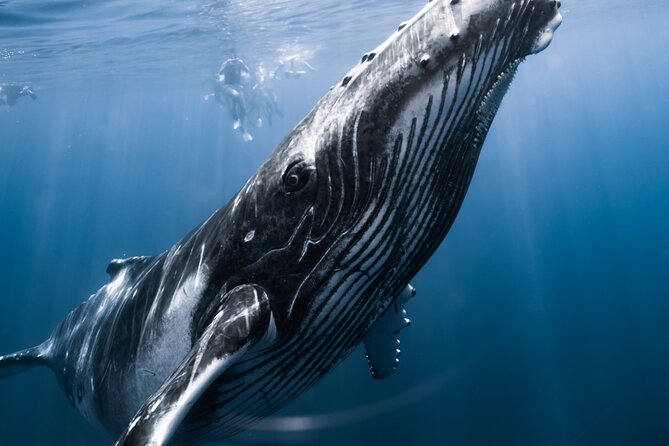
The best part of this Moorea outing is the chance to float above a mother and calf in open Pacific water, then watch them glide past or disappear into the blue. It is not a staged animal encounter. The whales choose the distance and the timing, so patience matters.
I like the six-person maximum, which gives the crew room to manage entries into the water and keep an eye on each swimmer. I also like the careful approach described by guides such as Johnny, Joe, Grace, and Laura, with clear safety instructions and explanations of whale behavior. The catch is simple: this is demanding open-water swimming, and rough seas or shy whales can turn a much-anticipated swim into a boat-based wildlife outing.
Key points at a glance
- Humpback season runs from July through late November, with the best encounters always dependent on weather and animal behavior.
- Only six people per boat may swim with humpback whales under 2025 regulations, keeping the group small and easier to supervise.
- Strong swimming and snorkeling skills are required, especially when the sea is choppy or whales move quickly.
- You may see more than whales, including dolphins, stingrays, blacktip sharks, and turtles.
- A wetsuit can be useful, since French law requires a life jacket unless you wear a shorty or full neoprene suit.
- The four-hour tour costs $305.30 per person, a high price that makes the small group and potential wildlife encounter important parts of the value.
Why a whale swim in Moorea feels different
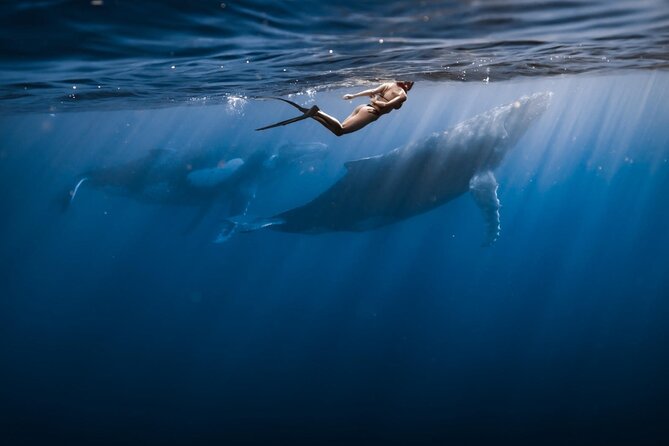
Moorea’s whale experience is built around wild animals, not a guaranteed performance. The crew searches from the boat, watches how the whales move, and decides when an entry is suitable. If a whale is resting, traveling, or behaving in a way that makes swimming unsafe or intrusive, you may spend more time watching from the boat.
That uncertainty is part of the deal. A lucky morning can bring a mother and calf close enough to pass beneath you. Some outings have included two or three entries into the water, with whales, dolphins, sharks, and stingrays appearing during the same four-hour trip. Other mornings bring rough water and no whales, though dolphins may still save the day.
The most important question is not how badly you want to swim with a whale. It is how comfortable you are in open water when the boat, current, and animal are all moving at once.
More Whale Watching Tours in Moorea
- Whale Tour – Observe and swim with whales
★ 5.0 · 257 reviews - Swim with humpback whales
★ 5.0 · 224 reviews - Humpback whale watching and marine life in Moorea
★ 5.0 · 199 reviews
What happens during the four-hour outing
The tour begins at Moorea Expedition in French Polynesia, with pickup offered for those who arrange it. The activity finishes back at the meeting point. Since the total time is about four hours, you get a focused morning or afternoon on the water rather than a full-day commitment.
After boarding, the crew provides snorkeling equipment and flotation devices. Bottled water is included. You need to bring your own sunblock and towel, and it is wise to arrive ready for a wet, exposed boat ride.
The first part of the trip is usually a search. The captain scans the water while the guide explains what to watch for and how the swim will work. You may spot whale blows or backs at a distance before the boat moves closer. The crew then assesses the whales’ direction, speed, and behavior.
If conditions are right, you enter the water with the guide. This is not a leisurely reef snorkel where you drift at your own pace. You may need to swim steadily to reach the right position, then remain alert as the whales pass, turn, or descend. A guide may direct the group to hold position, move aside, or return to the boat.
Some excursions have included two entries, and a few have included three. That depends on the whales and the sea, not on a fixed promise in the schedule. When the animals move away, the boat follows at a respectful distance or resumes the search.
The outing may end with a second wildlife stop. Dolphins, stingrays, blacktip sharks, and turtles have all been encountered on these expeditions. These animals are not guaranteed, but they can make the trip worthwhile even when whale conditions are poor.
The whale swim demands real water skills
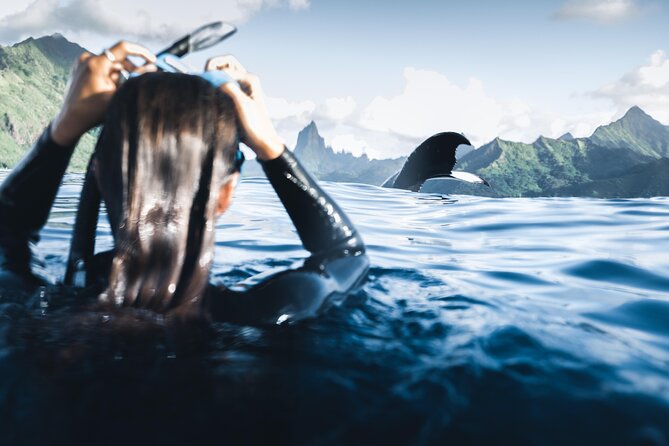
The operator requires strong swimming ability and snorkeling experience. Take that instruction seriously. Several parts of the experience can make the swim harder than it appears from the boat: chop, wind, current, a moving whale, and the need to stay with the guide and group.
You should be comfortable putting your face in the water, breathing through a mask and snorkel, and swimming in open ocean without a pool wall nearby. You also need enough stamina to move when instructed and climb back aboard when the guide calls you in.
A past incident described by a participant makes the point clearly. Two people were at the back of the group during the first water entry and then stayed on the boat for the rest of the trip. Do not count on the guide acting as a personal taxi. The crew’s priority is to manage the group and protect the animals, not tow every swimmer into position.
Non-swimmers can remain on the boat and watch the whales from above. That is a useful option, but if you already know you will not enter the water, the operator also offers a non-swimming tour. For this particular activity, you are paying mainly for the possibility of a close water encounter.
The life-jacket rule and why a wetsuit helps
French law requires life jackets for whale-swimming tours unless you are wearing a neoprene wetsuit. The exemption applies to a shorty or a full wetsuit. Life jackets are available on board, while wetsuits can be rented through a third party.
A wetsuit is worth considering for two reasons. First, it may let you avoid wearing a life jacket while swimming, if you meet the legal requirement. Second, it adds warmth and buoyancy during a long wait in the water. Several people specifically recommend bringing or arranging one.
Do not assume the boat supplies a wetsuit as part of the price. It does not. Contact the provider about rental details before departure if you want one.
Snorkeling gear and flotation equipment are included, but you should still make sure your mask fits before leaving the boat. A poorly fitting mask becomes a nuisance when your attention should be on the animal and the guide’s instructions.
More trips that get you in the water with whales:
- Private tour observing and swimming with humpback whales in Moorea
★ 5.0 · 126 reviews - WHALE TOUR – Watching and Swimming with Whales
★ 5.0 · 52 reviews - Moorea 4H Shared Boat Tour Whale Swimming and Snorkeling
★ 4.7 · 52 reviews - Sacred Experience Swimming with a Whale in Moorea
★ 5.0 · 46 reviews
What makes the guides and captain important
A good whale trip depends heavily on judgment. The guide must read the animals, the sea, and the group at the same time. The captain must position the boat without crowding the whales or creating an unsafe entry.
Johnny has been singled out for clear explanations, calm handling, and communication in both French and English. Joe has been praised for finding whales and guiding swimmers in the water. Laura has also been noted for keeping the swim safe and helping with the group. Grace has been associated with underwater photographs on some outings, though you should not assume a photographer or a photo package will be available every time.
The strongest part of the guiding is the animal etiquette. The crew is described as allowing the whales to set the pace, keeping a safe distance, and avoiding pressure when the animals move away. That matters both ethically and practically. A stressed whale is less likely to remain near the boat, and a rushed approach can spoil the encounter for everyone.
Language may be worth checking before you book. English instructions are available, but one participant felt left out during long stretches of casual conversation in French. Safety directions should be clear, yet if you want detailed interpretation throughout the trip, ask about the language mix when arranging your outing.
The best and hardest wildlife moments
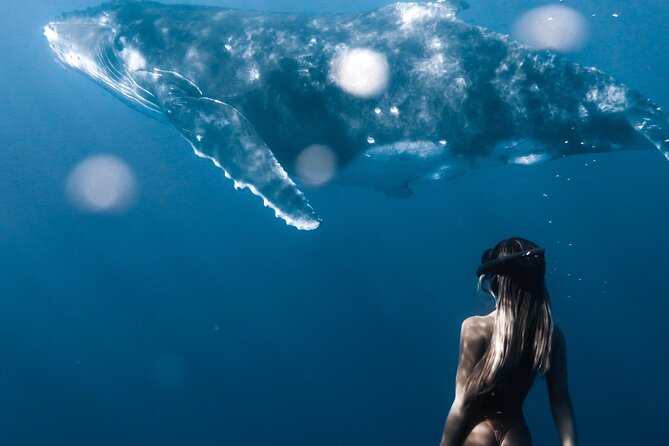
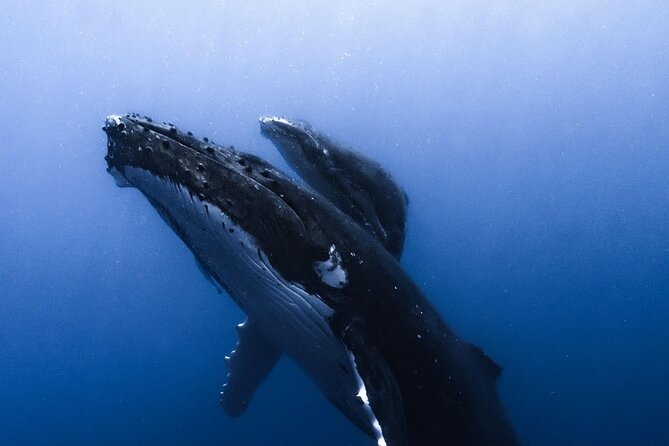
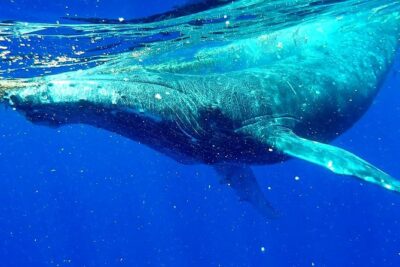
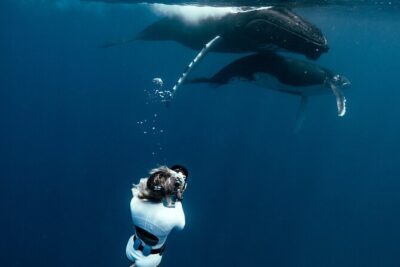
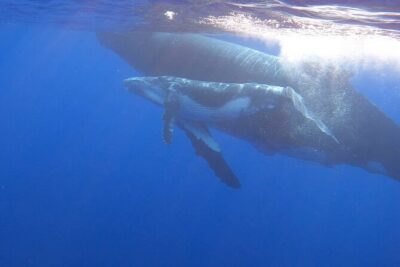
The most memorable encounters involve mothers and calves. A calf may surface beside its mother, pass in front of the group, or move beneath swimmers before both animals head down into deeper water. Seeing that from the water is a very different experience from spotting a whale from shore.
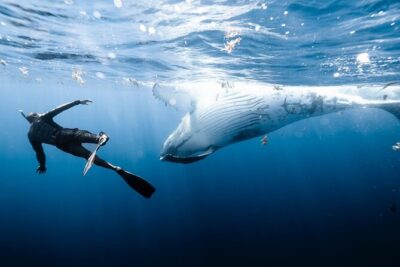
A few reports describe whales resting below the group before surfacing nearby. Others mention a whale swimming directly underneath. These moments may last only seconds, so you need to watch rather than spend the whole encounter adjusting a camera.
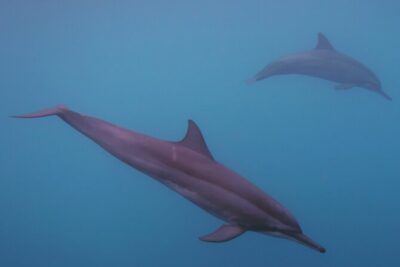
Dolphins are another possible highlight. One outing produced no whales in rough seas but still allowed a swim with dolphins. Stingrays and small sharks may also appear, sometimes at the end of the trip. That variety is a good reason to treat the outing as a marine-life expedition rather than a single-species guarantee.
The sea can change the tone quickly. One morning may bring calm water and clear visibility. Another can bring chop strong enough to cause seasickness or make it difficult to keep pace. If you are prone to motion sickness, taking your usual seasickness medicine before the boat leaves is a sensible precaution.
Cameras, photos, and keeping your attention on the water
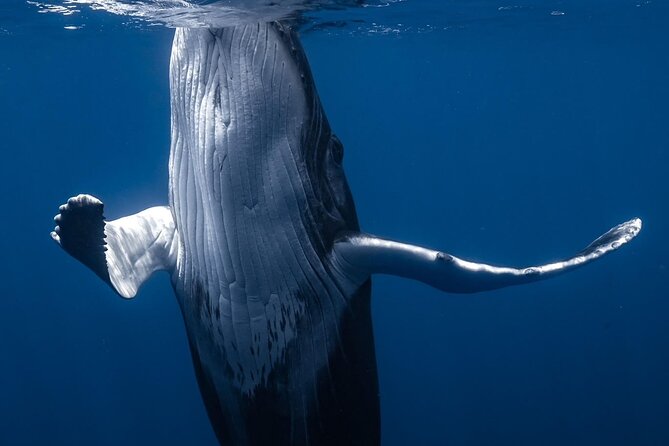
You can bring a GoPro, and an underwater camera can record the sound of whale song as well as the sight of the animals. A waterproof camera gives you the best chance of bringing home a memory, but it can also distract you at the wrong moment.
Do not rely on professional photos unless you confirm exactly what is offered on your date. A photographer may be present on some trips, but photo service is not listed as an included feature. If images matter to you, ask whether a photographer will be aboard, whether photographs cost extra, and when they will be delivered.
I would give the guide your full attention during the first entry. Learn the hand signals, understand where the group will gather, and watch how the whales move. Once you know the routine, take a few images, then lower the camera and experience the animal in front of you.
Is $305.30 a fair price?
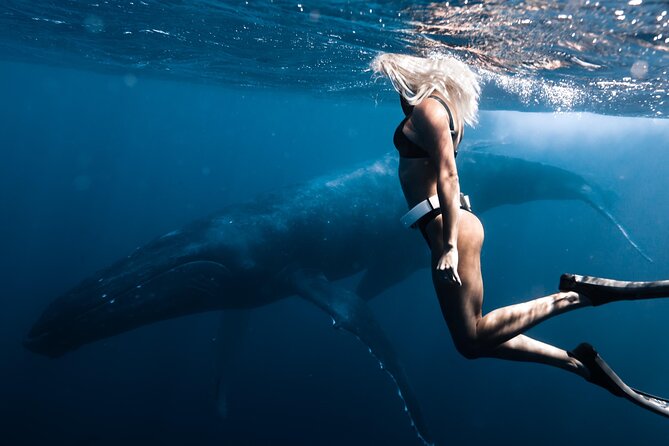
At $305.30 per person, this is an expensive half-day. You are paying for a small boat, a maximum of six people, equipment, a captain and guide, and the time and fuel needed to search a wide area for wild whales. Bottled water is included, but sunblock, towels, and any wetsuit rental are extra.
The price makes more sense if the small group is your priority. Six people gives you more space than a large sightseeing boat and makes it easier for the guide to track each swimmer. It also means fewer bodies competing for the same view when a mother and calf appear.
The value is harder to defend if your main goal is simply to see whales. You may see them from the boat, encounter another species, or find that sea conditions prevent a swim. If you need a guaranteed close encounter, no ethical wild-animal tour can provide that.
For someone who sees swimming with a humpback as a major Moorea goal, the cost can be justified by one extraordinary encounter. For a casual wildlife outing, the non-swimming option or a less specialized boat trip may make more financial sense.
Who should book this Moorea expedition
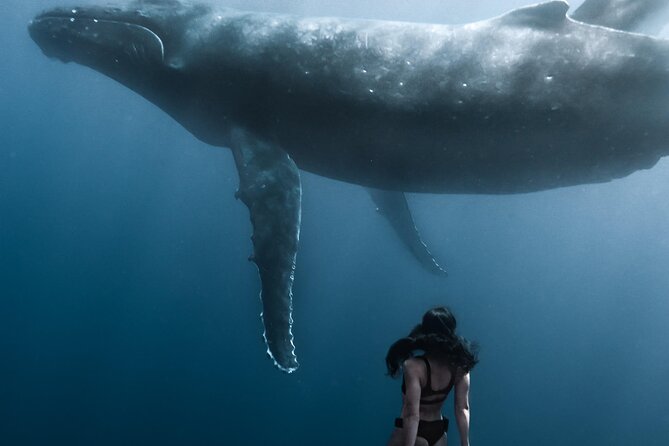
This tour fits you if you:
- Swim confidently in open water.
- Have used a mask and snorkel before.
- Can handle moderate physical effort and changing sea conditions.
- Accept that whales control the schedule.
- Care about responsible animal encounters.
- Want a small group rather than a crowded boat.
- Are willing to wait patiently between sightings.
I would think twice if you are uncomfortable in deep water, tire easily, or expect the guide to tow you to the whales. The crew can provide flotation equipment, but the activity still requires you to manage yourself in the ocean.
It can work for older swimmers too. One outing included people over 60 who kept pace with younger participants, but age is less important than fitness, confidence, and snorkeling ability.
Free cancellation is available until 24 hours before the start time. Changes or cancellations made less than 24 hours ahead are not accepted for a refund. Poor weather or failure to meet the minimum number of participants can cancel the trip, in which case you are offered another date or a full refund.
Should you book the whale swim?
Book it if swimming beside a wild humpback is near the top of your Moorea wish list and you are a strong, calm open-water swimmer. The small group, careful crew, and chance to see mothers with calves make this a serious wildlife outing rather than a quick sightseeing cruise.
Do not book it solely because you want a guaranteed whale encounter. You need patience, good conditions, and luck. If you can accept watching from the boat, perhaps seeing dolphins or rays instead, and letting the animals set the terms, this can be one of the most powerful experiences of your French Polynesia visit.
FAQ
How long does the Moorea whale-swimming tour last?
The experience lasts about four hours and ends back at the Moorea Expedition meeting point.
When can I swim with humpback whales?
The main whale-swimming season runs from July through late November. Sightings and water entries still depend on weather, sea conditions, and whale behavior.
How many people are allowed on the boat?
The activity has a maximum of six people. Under 2025 government regulations, only six people per boat may swim with humpback whales.
Do I need to be a strong swimmer?
Yes. Strong swimming ability and snorkeling experience are required for entering the water with whales. The effort is often easy to moderate, but it can become harder in rough seas or when the whales move quickly.
Can I join if I do not want to swim?
Yes. You can remain on the boat and watch the whales. A separate non-swimming tour is also available.
Is snorkeling equipment provided?
Yes. Snorkeling equipment, flotation devices, and bottled water are provided. Sunblock and towels are not included.
Do I need to wear a life jacket?
French law requires a life jacket for whale-swimming tours unless you wear a neoprene wetsuit. A shorty or full wetsuit qualifies for the exemption. Life jackets are available on board, while wetsuits may be rented through a third party.
More Half Day Trips in Moorea
- Franckyfranck Tours Moorea – Half day Tours
★ 5.0 · 817 reviews - Half Day Tour : Moorea Snorkeling & Sailing on a Catamaran named Taboo
★ 5.0 · 529 reviews - Moorea: Half-Day Open-Air 4WD Safari with Hotel Transfers
★ 4.6 · 240 reviews - Half day whale tour 4h00
★ 4.5 · 181 reviews
Just added around Moorea
- Moorea Highlights Private Tour: Natural and Cultural Attraction★ 5.0 · 7 reviews
- moorea tubing★ 5.0 · 12 reviews
- Whale Watching Moorea (non-swimming)★ 4.0 · 12 reviews
- Watch and Swim with Humpback Whales in Moorea★ 5.0 · 3 reviews
- Yoga at sunrise at Sofitel Moorea, overlooking Tahiti★ 5.0 · 3 reviews
- Snorkeling Tour in Moorea Aquatic Adventure Half Day★ 5.0 · 4 reviews
- Snorkeling Safari Moorea (Half Day Tour)★ 5.0 · 3 reviews
- Unique photo shoot in the heart DE Moorea: Beach & mountain combo★ 5.0 · 3 reviews
Swimming with Whales, compared.
Private tour observing and swimming with humpback whales in Moorea
Read our review →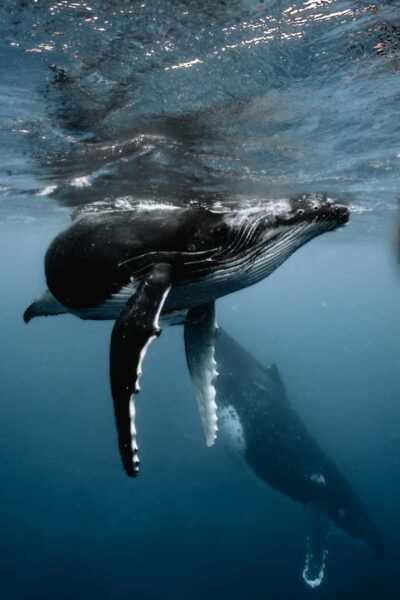
Moorea 4H Shared Boat Tour Whale Swimming and Snorkeling
Read our review →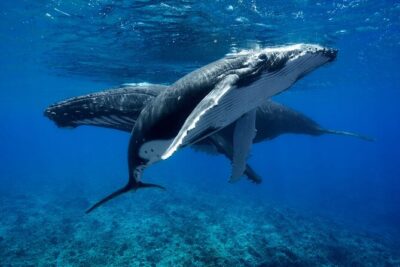
Sacred Experience Swimming with a Whale in Moorea
Read our review →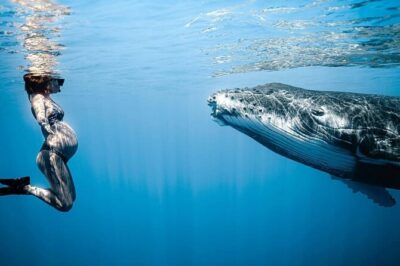
Browse the lists this tour appears in